Showing posts with label Society. Show all posts

Friday, December 17, 2010

Buses with Bathrooms?

Here's the question:
Planning on teaching in Korea (of course English) and hoping to travel all over the country. What I am concerned about is the long trips (3 hours or over) that you have to take on bus rides. Do these buses have bathrooms? I heard that during these trips people like to eat and specifically drink? During a bus ride and let's say for lack of a better word have to pee or even worse go #2, what do people do during these types of situations?
I'm a big fan of bathroom-related questions. You can tell a lot about people, cultures and history based on their bathroom habits, jokes and facilities.


I personally stay away from a lot of bus travel for this very reason. First of all, no buses available to the general public have bathrooms on them. Instead, the driver will pull into a very busy rest-stop at the halfway point on most trips over 2.5 or 3 hours. Of course, not everyone has the exact same bladder functions and this presents a problem. 


In all honesty, you have one option: begging the driver to pull over


In most cases, they will. It's not totally uncommon to see a bus in the shoulder and a lone passenger ducking behind the bushes. It's embarrassing for sure, but much better than, say, pooping in your pants.


Koreans have largely gotten used to this arrangement and since they're also the world's greatest transit sleepers, they generally doze through the entire process. 


In other words, make sure that you're empty before the trip and don't booze too heavily the night before.

Wednesday, June 23, 2010

Reporting Domestic Abuse in South Korea

Here's the question:
I have a problem, and I was hoping you might have some advice. In the apartment above me there is frequently domestic violence going on--I hear lots of noise and a girl screaming like she is very hurt. I have called the police multiple times. They come, knock on the door, but of course the people inside won't open the door, and the police won't open it either.
My school asked me if I want to move to a different apartment, but that does not solve the problem. I want to know, what can I do to help this girl? Every time I hear her scream, I feel so guilty. And when she stops screaming, I wonder, is it because the beating stopped or because now she is too hurt to scream?
I have Korean colleagues and friends, but all of them seem unwilling or unable to help me. Please help me help her!
What a terrible situation to be put in. I'm truly sorry that you have to endure being around such violence. I'm pretty sure I heard a little bit of domestic abuse when I first moved to Korea, but wasn't ever certain. As I've learned since, Koreans are sometimes a tad emotional and overly passionate, so screaming and crying might be provoked without violence. Also, Koreans have gotten used to noisy neighbors and tend to block the disturbance--whatever it might be--out. 


I'm not sure if you mean 'girl' as in a child or an adult, so I'll answer for both.  


If it is a child then the situation is a little trickier. Koreans very deeply use and approve of corporal punishment. While the trend might be slowing in the public school system, it is still very much a part of discipline in the home. It all boils down to respect and adherence to the hierarchal norms that Korean society is obsessed with. To some Koreans, if a child misbehaves it's not because they are a child or foolish, but rather that they intentionally chose to disregard the structure of Korean relationships and must be disciplined. The method doesn't matter to them as long as the child understands and follows the pecking order. 


In this sense, a call to the police over what a Westerner might call "child abuse" could prove to be useless. The parents would justify it and unless the child has severe or easily noticeable injuries (not just bruises), the police will probably overlook it. Remember, "culture" is always the excuse offered up when defending questionable behavior. I know that isn't comforting in the least for you, but that's how it goes. However, if you can spot the child out and about around your apartment, maybe say 'Hello' and take a causal look at her neck, arms and legs. If you see something questionable, contact one of the links below.


Now, if the 'girl' is a woman and, therefore, a battered wife or girlfriend, you can take more direct action. You could call the landlord or maintenance person and let them know of the "disturbance". You could try spotting the woman outside her place and having a face-to-face conversation with her (although she probably won't open up to you and language could be an issue as well). You could even try banging on the ceiling or their door while the abuse is taking place. The bottom line is that you need to make sure the abuser knows that other people know what's happening. 


I think calling the police over and over again isn't a bad thing to do at all. Eventually, the locked door excuse won't work (as they often do) and the police will demand entry. The problem is that the victim might not be interested in talking to the police. Koreans don't like legal solutions, nor do they like losing face. This situation offers both. Luckily, you're not Korean and you don't have to deal with the culture barriers.


If the police won't do anything and you're sure that your neighbor is being beaten and/or is in a helpless situation, then you could always go to Korean Women's Hot Line (www.hotline.or.kr) or visit the Ministry of Gender Equality and Family (www.mogef.go.kr). Both of them have English websites and I'm sure will be able to communicate with you considering the amount of abuse that takes place among foreign-born brides on the peninsula. It also wouldn't hurt to drop by Korea4Expats' post on Help Centers for Abused Foreign Women. Your neighbor might not be a foreigner, but they could at least give you some solid advice or point you in the right direction.


You have a few options for now and hopefully they will work out because this kind of thing needs to stop. Does anyone else have any advice?

Sunday, June 20, 2010

Why do Koreans smoke so much?

Here's the question:
Why do Koreans smoke so much? I'm from Delaware and am very used to a non-smoking environment. This is a disgusting shock.
For those who don't know, Delaware banned smoking in public workplaces almost a decade ago, so I imagine coming to Korea would be quite the shock. Some foreigners love it and others hate it, but Koreans are all used to it.


Korean men do smoke an awful lot (a trend increasing among women as well). It's hard to walk into a building or a bathroom without catching a whiff of it and while the government is trying to broaden their ban, it doesn't seem to have much of an effect on the prevalence. There are a lot of reasons why smoking among men is so common in Korea.


Military


Aside from the youthful temptations, curiosity and peer pressure, young Korean men must face the most difficult smoking challenge: military service. Up until the mid-nineties, cigarettes were provided to young soldiers along with their coffee and tea. The brands changed (Hwarang, 88, This) but they were free and presumably included in their Type 3 rations. Now, cigarettes are no longer provided, but they are offered at a discounted price. Of course, you don't have to smoke and while no one is forcing you to indulge, those who opted for healthy lungs often got stuck doing more work than their smoking counterparts simply because when you're smoking you're not working. As a result, many young men pick up the habit in the military and when they rejoin civilian life they have trouble shaking the addiction.


Self-Expression


If you were to ask a Korean why so many people smoke, they'll say that stress causes them to do it. Some will offer fun excuses like "I'd be much more unhealthy if I couldn't relieve my stress through smoking", but we know that doesn't make sense. Smoking might dilute the physical response to stress yet it does nothing for releasing stress or curing it. Everyone all over the world is stressed. Korea has not cornered that market. What's really at issue here is that Koreans typically don't use proper avenues for releasing stress. Instead of expressing themselves and sorting through the problems, many of them hold onto it (or jump off a building). 


Koreans might seem emotional when it comes to their national pride, but when it comes to themselves or their loved ones, silence is the answer. The reasons for this is a whole different topic in and of itself. In short, the curse of respect shines through. Burdening others with your problems is viewed as disrespectful and selfish. Throw that in with the fact that the Korean language is anything but loving and tender and you have a cocktail ripe for stress. And without a release for their stress, they look for ways to dampen it. Enter tobacco. 


Leisure Time


Yeah, Koreans don't have any. Sure they might go to Jeju for the weekend or a day trip on the slopes, but in general, Koreans do not have a leisurely culture. Because of this, they seek very quick and gratifying solutions. Smoking, drinking, room salons, sexy bars, kissing rooms, screen golf, PC rooms, game rooms and singing rooms are all quick ways to get your jollies. They can move from one to the other in a relatively short amount of time. It's a 빨빨 culture that prides itself on its pace. When generation after generation seeks this type of gratification, smoking will always find its way into the fold. In my building, there's an office where the men take smoke breaks every thirty minutes for ten minutes each time. If you do the math, you soon start to realize why they have to work such long hours.


Work Life vs. Family Life


This is a simple one. Work life is very important to the Korean man. If he's under fifty then you can assume that he'll be working everyday and most nights. It's not that he wants to spend time away from his family, but he has to if he wants to climb the ladder. When family is not the center of your world, then priorities change. At home, you typically want a nice, clean, quiet, peaceful and pure atmosphere that you have some sort of control over. At work, however, it's a fast-paced late-night drinking, smoking orgy of opposition to the atmosphere desired at home. By the time one reaches his fifties and is still smoking, they might say something like one of my older Korean friends did just the other day.
"Look at Korean life expectancy compared with nations who smoke less. Korea is higher than many of them."
 Cost

And finally, my biggest obstacle: cheap smokes. One of the first thing foreign smokers realize when they get to Korea is that cigarettes are cheap. I remember being pleasantly surprised by this when I first arrived. Except for a few places in SE Asia, it's hard to find Marlboro's for less than three bucks a pack. I'm sure there's some data somewhere to back me up or disprove me, but I'm willing to bet that the smoking rate would drop pretty quickly if the cost of smokes jumped to UK or Canada-level. Personally, I'm still wondering when the health care system will start to take a hit from all the smoking-related illnesses that are sure to continue increasing. (Smokes haven't increased in price since the year 2000. Someone's going to have to pay for the poor health of smokers.) Either way, the low cost is certainly keeping some potential quitters off the fence.

You certainly noticed that I only focused on men. Women and smoking in Korea is an interesting topic and while I'd love to tackle it in my own way at some point, we'll allow James from The Grand Narrative do what he does best and continue on with this topic.

Sunday, January 31, 2010

Scapegoating and being a good tenant

Here's the question:
I think I'm a good tenant. I separate my trash and recycling and don't make much noise, but my landlord constantly gives me bad looks. Is this normal? What can I do to make the remainder of my stay in Korea (8 months) better?
This is actually a more complex question than it seems. We're dealing with more than a rude landlord here. This touches on perceptions, responsibility and scapegoating as well as plenty of other issues.

I remember when I first got to Seoul, nobody had told me about the special trash-bags I had to buy, so I threw my trash out in a normal looking black trash-bag. That bag sat and sat until one day I returned from work to find the bag of trash in front of my apartment door with a note resting on top of the now opened bag of garbage. I brought the note into school and from that I learned about the special bags. Innocent enough and I never made the mistake again.

You would think that that would have been the end of my trash-related troubles, but it was in fact just beginning and one that I have dealt with many times since. Apparently, some of the Korean tenants knew about my trash-bag incident and decided to take advantage of it. So for the next few months, I was essentially framed by them. They would dump trash out improperly and make a big mess of the recycling and when confronted by the landlord, they would simply point their finger at me. And this scapegoating still continues today. I have a dog and when I walk him, I ALWAYS bag his shit. Sometimes I even bring water along with me to clean the piss. Yet, my landlord and neighbors always assume that the poop they see on the street is from my dog. 

I shared those stories with you because the bad looks you're getting from your landlord could be because someone is blaming you for something that you didn't do. The only thing you can do is make your trash-dumping process obvious and visible and continue being a good tenant. You could also mention this to your boss. They can't change much, but it gives you the chance to defend yourself.  If the landlord sees you doing everything correctly, eventually that image is going to stick rather than the image they have in their head of the lazy, dirty or confused foreigner. 

Koreans love scapegoating, so get used to it.

The tricky part of this whole thing is how are we, the foreigners, suppose to control or change this perception? It doesn't seem fair that we should constantly have to walk on eggshells so as not to give foreigners a bad image, but at the same time we should be responsible members of the society. The cards are stacked against us on this one and there's nothing that we can really do about it. Sure, we could volunteer or lead public awareness campaigns and even if we succeed in transforming the perception of foreigners in Korea, the scapegoating will continue. We're an easy target. 

The best way to combat it is to be a decent person in public. We stick out and will attract unwanted attention; sometimes that's good and other times it's not. All I do, as a manager, is tell my new teachers not to get too aggressive when drunk. That prevents a lot of problems.

That, or your landlord is just a cunt.

Monday, November 16, 2009

Friday the 13th in Korea

Here's the question:

One of my co-workers was talking about Friday the 13th and how this year was very unlucky because there were 3 Friday the 13th’s in 2009. Yeah, yeah, yeah, blah, blah, blah, I get it. Koreans are superstitious, but I really do wonder why she believed in Friday the 13th? Isn’t there an Asian equivalent?
Friday the 13th is one of those superstitions that everybody knows about, yet the origins are still pretty unknown. You can snoop around Google if you really want to get a look at what some people think, but it doesn't really matter. Maybe I'm wrong, but the fact that I had to look-up the origins of the date suggests that I'm more aware of it only because of what happened at Camp Crystal Lake back in 1980 and since "Friday the 13th" is ranked in the top ten movie franchises of all time, there's no doubt that the slasher flick had some sort of effect on many Korean nationals from that generation as well. Simply put, eveybody in the globalized world is probably aware of the Jason's hockey mask (and Freddy's metal-clawed brown leather glove) as it has been referenced over and over again in pop culture.

As far as an Asian equivalent, I'm not sure. I don't know what all Asian people believe and I don't believe there's a Korean equal to such a day, but there are a few loosely related things that come to mind. I don't want to even begin to compile a list of Korean superstitions and myths myself, but maybe a few just get the conversation flowing.

The Number 4

While it's hard to say whether or not the number "4" is as universally feared or disliked in Korea as the number 13 is in some other nations, the fact that many elevators in Korea read 1...2...3...F...5... is at least an indication of its fearful roots. In the Chinese language, the word for "death" sounds just like the number "4" in the Korean language ("사")  and since many cultural and lingual traits of China have trickled into Korean culture, it's no suprise that this one stuck. I wonder though, does China also omit the number 4 from elevators? I've been there, but I think the massive amount of Tsingtao blurred my elevator experiences. Or maybe I didn't have any.

Fingernails

Don't throw your fingernail clippings on the street. Otherwise, a rat (or mouse) will eat them and therefore consume a part of your soul. If you do happen to accidentally do such a thing, don't worry. All you have to do is get a cat to eat the fingernail-eating rat and BAM! -you've got your soul back. Of course no really buys into that, yet it's not too uncommon to see Koreans wrapping their clippings in a paper towel or toilet paper before disposing of them.

The Morning Spider

Never, ever, ever kill a spider before noon. If you do, brace for bad luck. Why? No idea, kiddos. I've just heard this one too many times not to mention it.

The Red Name

Anyone who has taught kids here has heard that writing someone's name in red suggests that they are dead. And if they are still alive, then it's bad luck. I used to do it just to get a rise out of some of the naughty kids, but don't have the chance to do so anymore.

Who else had heard some interesting superstitions? Oh, and I please no kimchi/fan death comments.

Friday, October 23, 2009

Spanking and Love Sticks

Here's the question:

I teach in a private academy and am probably naive, but I read about a "love stick" in the Korea Herald the other day and was wondering if parents knew about the use of them as well.

You are being naive and I assume you're talking about Brian's piece on "Discipline in the classroom."

"These days corporal punishment in school is technically illegal, though still widely practiced. However, both the larger size of students and the widespread possession of cell phones with cameras has made teachers think twice before using the "love stick."


The use or sight of the love stick or "사랑의 매" is extremely common in Korean schools. But as Brian mentioned, kids are using their phones as protection against their use. YouTube features some pretty brutal videos of corporal punishment in Korean schools. I should point out that not all objects used to hit students are officially love sticks. While some teachers clearly prefer love sticks and brooms, others go for bamboo sticks or the good ol' fist.


You and I know that abusing children is disgusting and should result in jail time, but as the quote above says, schools usually try to circumvent law or superficially ban the practice by outlawing cell phones in class. Just this year, a student was flogged over 100 hundred times on the feet only to go home and commit suicide. The punishment was for being absent from the after school study session that all high school students are required to attend. The story here is not that a teacher hit their students, but the level of acceptance that the other students displayed.

"Students in the school told the investigators that the degree of punishment the student received actually "wasn't too harsh" compared to the "usually very harsh punishment."
Throw that in with this 2004 study and you've got a majority of students who simply are not all that affected by this abuse.

최근 한국사회조사연구소가 전국 272개 초·중·고교생 8100여명을 대상으로 설문조사한 결과에 따르면 응답자의 79.6%가 '올해 교사에게 체벌을 당한 경험이 있다'고 답했다. 응답자의 15.8%는 자주 체벌을 당했다고 답했다. '체벌 경험 비율'을 연도별로 살펴보면 △1998년 93.7% △2000년 85.0% △2003년 86.3% △2004년 79.6%로 학내의 체벌 문화가 점차 개선되고 있는 것으로 나타났다.

That says that 79.6% of respondents experienced some sort of physical punishment while in school. It's clear that the numbers are going down, but 79% isn't in anyway a low number. (I couldn't find a recent stat.) Why so common though?

I blame the parents.

First of all, parents often times buy these love sticks for teachers as a signal that beating their child (if necessary) is okay with them. I have seen many love sticks in my years in this industry and teachers usually have a few of them in their classroom. Some of them might be in plain sight and others might be in a closet or desk drawer. They're there though and if the parents are giving them to teachers, you can guarantee that they have them at home as well.

Secondly is the fact that companies actually specialize in selling these sticks.


Look at that picture. It's actually not the official "love stick", but rather a "discipline stick". The very fact that these are being sold is a pretty huge indicator that it's still quite prevalent. However, not all parents spend money on these sticks. Some make them themselves and force their kids to take pictures with it.


"Smile or I'm going to hit you!"


I have yet to find more than a handful of adults who have not experienced some sort of corporal punishment from their parents. Some got popped with a shoe horn and others got the ladle. Without jumping into Confucianism in Korea (which really tires me out), let's just say that it's what today's parents learned from their parents, so they do the same thing to their kids. Stuff Korean Moms Like has a more playful take on the whole thing as well.

Face it, many of us have been victims to some of the classic forms of Korean Mom punishment. Whether you were forced to kneel and carry a large bucket of water above your head for hours at a time, told to go and collect your own whip/switch from the backyard, or simply stand with your hands in the air, just know that the worst is not yet over my friend. You can never outgrow Korean Mom punishments. As long as she is able bodied enough to wield a tree branch, a rice paddle, or raise her voice, she will punish you.


I assume that in twenty years, this too will be a thing of the past. After all, Jesus started it.


I must say though, it's easy for me to shit all over Korean parents for this practice, but the truth is that it's not limited to Korea. Sure, the love stick seems to be part of Korea's "unique culture" and we "must understand", but American schools did the same thing as did parents. I wasn't ever hit or spanked by my parents, but I do recall my mom threatening to "wash my mouth out with soap" every time I brought home a new bad word from school.

I think the best way to get this practice to stop is for the Korean media to publish these results.


If only we could tie-in lowered 수능 scores then I'm certain the abuse would stop.

In the end, it's more about the lack of a nurturing environment at home that usually accompanies this type of discipline. The abuse is just part of a whole range of parental failures and hopefully the next generation of Korean parents will pick up the slack.

So, yes. Parents are very aware of what's going on.

Tuesday, October 13, 2009

Korean Derangement Syndrome

Here's the question:


Dear Expat,

I am an anonymous blogger who runs a moderately successful Korea-related blog. Earlier this year, I wrote what I considered to be a well-researched article on fan death, demonstrating that it is indeed plausible. It generated a strong reaction immediately, but what was notable was that even after 10 months, many expats absolutely cannot get their head around the idea that fan death is real, even though I explained the science step-by-step and provided external citations from a climatology expert and the U.S. EPA. At best, those expats cannot believe that my post cannot be anything but satire, and at worst they throw verbal feces at the post, the blog, and my intellectual ability in general. Not even my fabled Korea-Japan Saga generates this level of bile and animus.

Pray tell, the Expat -- What is it about these expats that makes them behave like birthers screeching even in the face of Barack Obama's birth certificate? Why do they hate fan death so much?

- Assiduously Adding Knowledge!


Most of you can tell by the tone and humor that this questioner is none other than the inspiration for Ask the Expat, The Korean. Naturally, he asks one hell of question as well.

I spent a good half-hour reading his post again and the subsequent comments. The overriding majority of them were people trying to poke holes in the argument by over-sensationalizing a tiny part of The Koreans argument. The rest of the comments were either in agreement or under the impression that the Korean was joking around. Read them yourselves. Oddly enough, that thread is more civilized than most Fan Death threads.

The best thing to do is this:

First, find an English teacher. No wait, find twenty; a hundred, it doesn’t matter how many, just find them. I don’t care where they’re from or what they look like. Now that you have their attention, tell them that kimchi reduces the aging process and helps keep skin younger and fresher. No wait, that’s not good enough. Tell them that you believe in fan death and just sit back and listen to them roar with laughter and accuse you of being illogical, irrational or just plain ignorant. Wait until the laughing and name-calling subside and then tell them that you still believe in fan death. Careful though, their head might explode or they might launch into a self-praising tirade about how science and logical reasoning works.

Some of you might be laughing now. Some might be making really clever insults up like how I’ve "been in Korea too long" or that I probably think that "kimchi is very spicy". That’s fine though. I don’t suffer from Korean Derangement Syndrome (KDS). This syndrome is a self-imposed barrier that blinds and forbids the mind from accepting anything that doesn’t fit into one’s pre-determined narrative of who Koreans are and how they think. It’s an illness that forces the brain to disregard proven facts and instead offer knee-jerk reactions based on unfounded and unwarranted emotionalism.

The origin is hard to figure out, but I think it has to do with Korea's constant claim to superiority over other Asian (and western) nations. We could be talking about how scientific Hangul is, why Koreans are good at golf, or how chop sticks have made Koreans so good at hand sports, it doesn't matter. There's just something about these superiority claims that riles people up. After reading and hearing about so many Koreans who belief such claims, the reaction starts to become more and more aggressive and dismissive.

If you hear it too much, KDS can be triggered simply by someone highlighting a point of pride in Korean history or culture. It doesn't even have to be a contentious point. Like this:

"Did you know that in the founding legend, Dangun's mother was named Ungnyeo?"

"What? That's so stupid! Koreans are so gullible to believe that myth! Where's my Bible?"


That might be an extreme example, but the point is that KDS has trained people to react this way. Do people view it as a threat to their own idea of supremacy?

Let’s take a look at the fact that kimchi is easily among the world’s healthiest foods. Those suffering from KDS would claim that Koreans are just being overly nationalistic in their enthusiasm, but Health magazine says,
"Kimchi is loaded with vitamins A, B, and C, but its biggest benefit may be in its “healthy bacteria” called lactobacilli, found in fermented foods like kimchi and yogurt. This good bacterium helps with digestion, plus it seems to help stop and even prevent yeast infections, according to a recent study. And more good news: Some studies show fermented cabbage has compounds that may prevent the growth of cancer.”

Unfortunately, facts don’t matter when dealing with KDS-infected expats. They can be shown an extremely comprehensive study proving the claims’ validity, but it will still be wrong. In their perfect minds, they’re correct and the Koreans are trying to make themselves appear more exceptional than they deserve. Luckily, since KDS became so fashionable among expats, Koreans can no longer be proud of kimchi. Phew! That was close!

How about fan death? Most expats don’t bother to look into the science of fan death and rely on faux-claims of suffocation and hypothermia, but if they were to inform themselves, they would see that fan death is in fact very true and very real (albeit rare). Luckily, just as the Korean understood, he knew not to quote a Korean scientist and went with an American source known as fucking the Environmental Protection Agency,

"Portable electric fans can increase the circulation of hot air, which increases thermal stress and health risks”
and
“Don’t use a portable electric fan in a closed room without windows or doors open to the outside.”

Hyperthermia is what could get you, but again, those pesky facts don’t matter because someone told those freshly-minted expats that Koreans are unreasonable. How else could they believe in such a thing?

I wish I could say that it’s limited to those two items, but I would be lying. As I mentioned above, sufferers of KDS have deeply-instilled gut-reactions to many points of Korean pride. Dokdo and the East Sea come to mind. While the argument is one that continues to truck along, many expats prefer to assume that it’s Japanese territory and that Koreans are just overacting. You will probably be laughed at by some if you make the simple statement that Korean history started in 2333 BCE when Gojeoson was founded. In their superior minds, Korean history started in 1953. I could talk about spicy food, dog meat, medicinal food and Korea’s clearly unique and separate cultures from China and Japan, but it would do no good. Korea Derangement Syndrome is just too strong for facts.

And if it sounds like I’m talking down to those who suffer from KDS that’s because I am. It’s a willful ignorance that parallels the loons in the US who believe that Obama is not a natural born citizen and that he wants to create death panels, also known as “birthers” and “deathers” respectively. I don’t know if KDS is about western superiority or arrogance either; it’s just a blatant denial of facts which don’t fit into a fixed idea of what Korea is or should be.

I must say that I can understand a bit of my fellow expats frustrations. Sometimes it's hard to find a lot of diverse opinion in Korea. If you ask one Korean about a particular issue, there's a high chance that a large majority of other Koreans feel the same way. Take the stereotypes that teachers or American military personnel put up with. We are both accused of being criminals, but that's just not true. The US military is still viewed as 100% guilty for the Armored Tank incident and that's all the Korean population needs to know. Of course, as GI Korea knows, there's much, much more to the story, but Koreans know what they know and they don't care. Did you know that Yongsan Garrison's soil has been destroyed by the American military? Expats might not know that. The US military might not know that, but the Korean people ALL know that.

The point is that Koreans take a lot of what they hear at face-value. I'm not saying they're gullible or unreasonable, it's just we -the expats and non-Koreans- have to put up with so much misinformation about us and the world's interaction with Korea that after awhile we shut-down and start rejecting everything we hear as being bullshit. It's not fair, but the fault falls on both sides.

I would recommend that Koreans tone down a bit and double-check their own facts and figures and that my fellow expats start reading books and papers a bit more and rely less on what online forums and whiny short-term expats claim. I understand that some might get tired of hearing about the same Korean highlights over and over again, but no one is forcing you to repeat or promote them. Do some research; make up your own minds and stop following the lead of that one expat who infected you with KDS.

So, it's not fan death. It's being bombarded with reasons why Korea is special.

Thursday, October 8, 2009

Why is Christmas a romantic holiday in Korea?

Check out the podcast if you have a few minutes.

My ideas...

  • Separation of Christianity, Santa and family traditions from the now Koreanized holiday
  • Commercialization and Pop Culture
  • Lack of romantic opportunity, expression and the prevalence of romantic holidays in Korea

Anyone else want to add anything?

Wednesday, October 7, 2009

Are birthdays important in Korea?

Here's the question:

I have a Korean co-worker who has a birthday coming up and when I asked her if she was celebrating with anyone, she said "no". What's going on here? Do Koreans celebrate birthdays?


Odd really because Koreans, like everyone, love to celebrate their own birthday. Who wouldn't like an entire day where you can guilt other people into celebrating YOU? I just had my birthday and even though I didn't guilt people into anything, I had fun being special for the day. In this specific case, I going to have to conclude that your co-worker was just not that into you and probably didn't want to share her day with you. Sorry.

There are a lot of holidays in Korea. Some are national and others are family-oriented. This past Chuseok alone saw a 25 million people traveling around the peninsula which is a huge number and obviously a very celebrated holiday, but is it the biggest or most important? This got me thinking a bit, so I asked about 50 of my students what they thought with a quick survey.

First question: For you personally, what is the most important holiday in Korea?


Second question: For the Korean nation as a whole, what is the most important holiday?


Individual Koreans thought that Christmas, their own birthday and Lunar New Year (설날) were the most important, while as a nation, Lunar New Year, Harvest Festival and Solar New Year were the most important. You can look at the breakdown yourself.

Clearly, birthdays are important to Korean people. I should also note that 환갑, or the celebration that commemorates a person hitting the age of 60 (and now 70) received a lot of attention in the second question, but that's likely because it's viewed as more of a milestone than an individual celebration.

There's another story here though, but before I address it, I'll need to create a survey for you guys. Stay tuned on that front.

Monday, September 28, 2009

Weddings in Korea: How much will it cost to attend?

Here's the question:

The principal of my school invited me to his daughter's wedding. How different are Korean weddings from Western? What kind of gift should I bring? What is appropriate to wear. Are there any big faux paus to avoid?

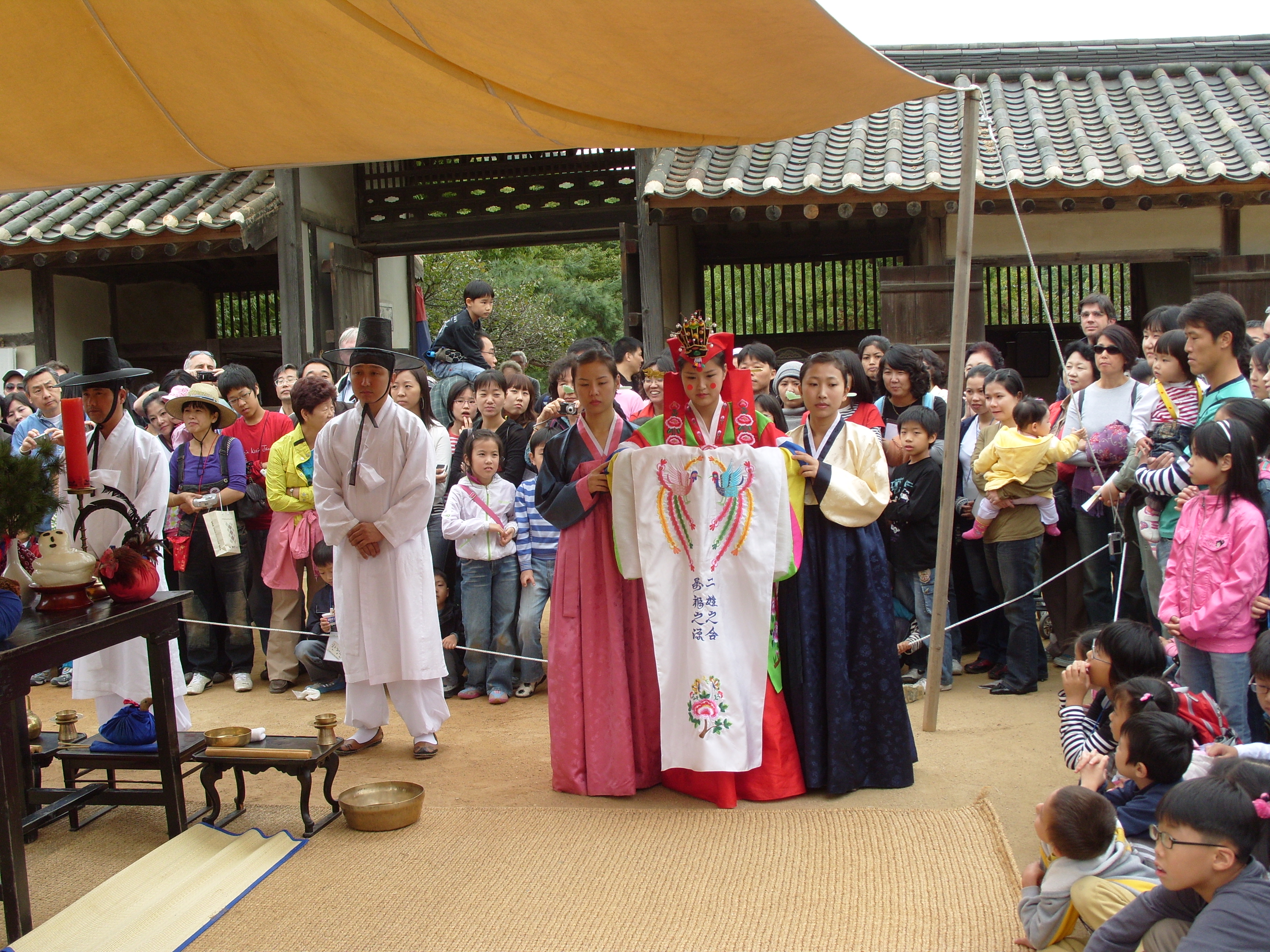
There are two types of weddings in Korea: Traditional Korean and a Western white wedding. If we really wanted to split hairs, we could throw in different religions which, of course, prescribe to a specific ceremony, but for the most part those two cover the majority of weddings held in Korea.

The traditional wedding is always fun to watch. I had a traditional Korean wedding myself and still love going and watching them if I happen to run into one. They're just that fun. The rest of the weddings that I have been to have been in wedding halls. These are fast, loud and busy affairs where best friends are sitting in the back joking around and talking on their cell-phone as the parents look on -totally expressionless- while the bride is crying uncontrollably. Seriously, I don't like the wedding hall weddings and I don't think I need to say much more to show the contrast between Western and Korean weddings.

If you want a pretty solid summary of weddings and marriage in Korea, Wikipedia offers a pretty comprehensive look at what's going on.

Now, you mentioned clothes and gifts. With clothes, dress seasonally and formally just as you would at home, but as far as a gift goes, it's better to give cash rather than an item. Money is the biggest concern for newlyweds and since some Korean men and women have such unrealistic expectations when it comes to finances, you'll never ever go wrong with a cash gift.

The amount depends on how close you are to the bride/groom. When you walk into the wedding hall or venue, you'll see a table probably sporting an oversized photo along with the name of the soon-to-be-spouses. (On a side note, my wife and I took pictures for over eight hours straight. The pictures turned out great, but it was exhausting to say the least.)

How much money to give?

The standard rate used to go as follows...

* 30,000 won for an acquaintance or someone you're not too close with.

* 50,000+ won for a co-worker or friend.

* 100,000+ for family and old friends (Koreans typically stay in close contact elementary, middle and high-school pals).

Now, however, with the introduction of the 50,000 won note, the minimum has unofficially risen to 50,000 won and, while some people might use the old standard still, it's safe to assume the all the numbers have been adjusted accordingly. Some people even consider how much money to give based on how certain they are the newlyweds will return the favor when it's their turn to get married. For this reason, many Koreans dislike peak seasons because of the high costs.

The method for payment is simple. Go to 711 and buy some celebratory (or just plain) white envelopes. Stuff some cash in it and write your name on the outside. When you arrive at the venue, hand it to the collection table, sign the book and they'll give you a ticket which will get you into the buffet either before, during or after the ceremony. If you're a little late, then wait to go into the buffet until after the post-wedding pictures have been taken. (I've always had a suspicion that the only reason some people attend these things is to get in the picture. Why else would everyone be so rude and talk during the actual ceremony?)

I always encourage people to go to weddings and it never hurts to be a part of something that is so important to your boss. As far as money goes, I think you'd be safe slipping in 30,000 and calling it a day. After all, you're new to the whole thing, so a 20,000 won (faux) mistake is harmless, right?

Friday, September 25, 2009

Chuseok Gifts and the Foreigner Experience

Here are the Chuseok-related questions:

Chuseok is coming up and I'm curious as to what exactly happens. I've discussed it with the Koreans I work with and while it's interesting, much of what they tell me centres around their family's traditions. What I'm wondering is:

- are there traditions that foreigners are expected to take part in? I've seen a lot of gift packages in Kim's Club and the like; are we expected to give gifts?

- what shuts down? Do the buses and subway run on a reduced schedule, or are they 100% closed?

- is it only family-based, like the Thanksgivings I'm used to back home in Canada, or is there a way to take part in a Chuseok tradition - for instance, a "Chuseok meal" in a restaurant?


--and---

I used to work for a hogwan and now I have a much better job teaching at an elementary school. My Korean co-teacher has been very helpful with both school stuff and non-school stuff like dealing with my apartment and setting up an new bank account. I was wondering what might be an appropriate gift to show my gratitude. Should I also get her something for Chulsuok? I should also get something the woman volunteer who helps out with the after-school classes. Any suggestions? What is the protocol here? And should I also get my Principal something?
Simply put, Chuseok is a harvest festival where Korean families gather together (usually in the husband's hometown or the oldest son's home) and celebrate the harvest, eat traditional food and pay homage to their ancestors.

Here I am a few years ago...

First we give thanks and bow to the harvest (Spot the white guy!):


Then we offer it to our ancestors:


And after eating and drinking, we head to the tombs:


That's the ritual and just about as involved as any non-Korean will ever be in the holiday. Unlike myself, most expats here are not married to a Korean, so your participation is limited to enjoying quiet city streets (unless you live in a "hometown") or getting slammed by hours and hours of highway traffic. All public transportation remains the same though. You'll find that a lot of restaurants and stores are closed, but it's not that big of a hassle.

The gifts are part of the fun as well. Korea Times ran a piece today about parents bribing teachers for the holiday, but there are certainly less-tainted gifts that people exchange.

For an older person or boss, most people buy honey (the expensive kind) or a fish called 굴비. For someone close to your age or a colleague, it's pretty common to buy them some dried persimmon () or other dried fruit. Some people try to get away with the famed Spam gift set and even though it's presence in supermarkets might say otherwise, it's viewed as a little "low-class" or "out-dated" these days. For kids, you give them money. If you don't want to be that specific, deok is probably the safest holiday gift and very easy to find.

As far as your holiday plans, either plan a trip out of the country or book your train tickets now because you don't want to deal with Chuseok traffic.

Wednesday, September 23, 2009

Cigars in South Korea

Here's the question:

First, I am a smoker. Not a cigarette smoker, but a cigar smoker. I am not an avid smoker...I can survive without cigars...but I would like to know how cigars figure into Korean culture. I've noticed that there are plenty of cigarette smokers around (all males, it seems), and I haven't noticed any kind of smoking ban (although no one seems to smoke in restaurants - thankfully). However, what I'm asking is: Does anyone in Korea smoke cigars (real cigars - not the ones from the convenience stores)? Does Korea have any cigar stores/shops? Are cigars expensive here (U.S. prices range from $5~$12 for a typical cigar)?


Smoking in Korea is pretty much second-nature. Korea boasts one of the highest numbers of cigarettes consumed per capita and cigarettes, despite being responsible for the rise in heart disease and lung cancer, have largely escaped the heavy tax that many other nations have levied in hopes of curtailing the deadly habit.


As far as most smokers being male, I agree to a point, but it is certainly becoming more common to see young women lighting up in the confines of a smokey bar or hof. Some of the bolder ones are sucking down on the streets as well. However, there are still a lot of rules and some taboo-elements when it comes to smoking in public. For instance, many Korean males will not smoke in front of their bosses. Of course, the boss doesn't care that their employees smoke, yet subordinates continue to file out the door and out-of-sight to light-up. Much like many Western families, it's also rude to smoke in front of family members. I assume that many of these practices will become obsolete in time. Further, I'm not too sure what restaurants you happen to be eating in, but I would be hard-pressed to find one that isn't cloaked in a thick layer of smoke. I guess most of the Western or "family" restaurants don't allow smoking though.

I digress. As you mentioned, nearly every convenience store sells some sort of cigar. They're usually pretty low quality and, from my experience with fellow expats who have been cajoled in quitting smoking cigs by their girlfriends, they smell rancid. However, I am not a connoisseur in any sense of the word. Luckily for us, some one else is.

The Seoul Cigar Aficionado Society, which may or may not be active anymore, offers a short list of spots to purchase cigars.

As much of South Korea's population lives in the capital, Seoul, it is easy to understand why Korea's only cigar shops are in Seoul as well. As of this posting date, there are only three cigar retail locations with a wide range of cigars to choose from.

1. Maska's Cigar at the JW Marriott Hotel - Cuban, Non-Cuban, and Flavored Cigars such as Vanilla, Rum, Chocolate, Honey, Cherry, Peach, & Blackberry.
(Email: maska.inc@gmail.com, Tel: 02-6282-2922, Web: www.maskascigars.com)

2. Pierre Ltd. at the Intercontinental Hotel - Cuban
(Email: pierre@pierrecigar.com, Tel: 02-790-4522, Web: www.pierrecigar.com)

3. Bluebell Cigars at the Shilla Hotel - Non-Cuban

For more detailed answers, email us at: SeoulCigarAficionadoSociety@gmail.com.


I wish I knew more, but there just isn't a big cigar-puffing culture here. I would suggest starting there and see what you come up with. Any cigar smokers out there care to take a stab?

Friday, September 11, 2009

Muslims in South Korea

Here's the question:

I'm a Muslim/UK citizen and interested in coming to Korea to teach. I saw a recent article about Islam in Korea and was wondering how I might be looked upon.
I assume by "recent", you mean THIS article (or this one) and if that's the case, I commend you on your reading of Korean papers before you make the leap.


There's some, but not an overwhelming amount of decent English info on Islam in Korea. Sure, you can read Wikipedia (which I found pretty interesting) or some other "Islam in Korea" pages, but other than a few snippets in the news, there isn't much on how you'd be treated here. I'll try my best.

Since Korea has a pretty high number of non-religious citizens and religious persecution is relatively low (although Islam has a tendency to be tied to terrorism in the minds of many Koreans), I think the best way to go about this is to highlight the fact that non-Korean Muslims here are viewed as very foreign. As I mentioned in a comment on Diffism, there are different categories of foreigners and each one typically carries a certain reputation or stereotype.

You can pretty much break it down like this: Caucasians (teachers, military, government, contractors, business-types and tourists); Asian non-Koreans (laborers, cooks, nannies, tourists and "entertainers"); and other. The "other" is where many western-Asian/Indian/black or otherwise dark-skinned people would be categorized because many Koreans aren't sure where to put them. True, there are hundreds of black teachers here and probably thousands of dark-skinned contractors, businessmen and skilled laborers working here, but the average Korean just doesn't know for sure.


For instance, if an Indian fellow was walking with a bunch of Korean businessmen at lunchtime, it would be assumed that he's involved with business in someway, but if he was alone, it's pretty unlikely that he would be considered to be part of the business crowd. Another good example of this on Korea Beat today. The police refused to believe that an Indian man could be a professor at a Korean university.


Since I don't know your race or ethnicity, I won't offer any simple race-relations tips, but if you were to wear an igal or a thawb, I can say for sure that you'd be given a few looks, yet I wouldn't expect anything worse than what you are used to in the West. Exposure is a huge part of tolerance and acceptance here and since the Korean Muslim population is very small (only a few mosques with 30,000-70,000 followers), the average Korean just doesn't have much experience to go on. You can largely avoid this if you live in Itaewon, but that might not be what you're looking for. I would suggest checking out the Seoul Central Mosque though.

The government is trying to promote closer ties as well. I think you'll be fine and might even find a nice little community to join if you felt so inclined.


***Update***

September 26th, 2009: Korea Times reports on feuding going on within Korean Islamic groups over the misuse of donations.

Wednesday, September 2, 2009

Where do young Koreans go for sex?

Here's the question:

I have a short question: Where do young Koreans go to have sex? I mean, they all live with their parents, right?


Short question with a long answer. I'm going to broaden the scope of the question by expanding "sex" to include all forms of hanky panky.

You are correct that Koreans tend to live with their parents until marriage. There are exceptions to that (moving to Seoul from X small/country city, divorced parents, good job, long commutes etc...) and more and more Koreans are choosing to move out, but the norm is still to stay at home, especially considering housing costs. The Grand Narrative has an excellent write-up on Flatting, Premarital Sex and Cohabitation in Korea, so check that out for sure. I can't any solid "First Age of Sex" surveys on Korea, but I did find this one.


I took the average of the East Asian countries in the survey and hit close to 18 which is just above the global average. I don't have any reasons to think that Korea is that much different than their neighbors, but I'm sure some of you Korean sociologists might be able to add some thoughts.

So, with all of these people living at home, it begs the question as to where they are going to have a little consensual fun. We know that the people in or beyond their late 20's (with money and a little courage) can simply stop by their friendly neighborhood love motel when the urge hits, but what about the rest of the youngsters? Going to a love motel is pretty suggestive, a little more pricey and if people just was a little over-the-shirt lovin', a motel might be too much.

There are options...

DVD Rooms

Judging by the name, these places seem quite innocent, but once you walk in the door and find a bed or huge bed-like couch where the standard couch used to be as little as five years ago, that innocence disappears. I can't find the link, but a few weeks ago, I saw a survey on Naver which said that the number one place for "college students to have sex for the first time" was in DVD rooms. Korea Times also has an article mirroring those results. They're cheap, sound harmless and carry less of a stigma than the love motel.

Noraebang

Like the DVD rooms, the noraebang typically offers privacy, low prices and very little shame. A young couple can go in there and sing, dance, smoke, drink and smooch as much or little as they want.

Love Motels

You all know the love motels by now. I wrote about them and Brian loves to write about them. They come fully equipped with lotions, condoms, tissues, overly fancy shower and bathing facilities and, of course, softcore Korean porn to help the shy young lovers get in the mood. While going to these places might be a bit intimidating for first-timers, the sheer seediness will take care of that apprehension. They're also pretty cheap and oftentimes have hourly rates.

The Park

Don't believe me? Go to Hangang Park late at night on the weekends. Not only will you see the sex-starved twenty-somethings snuggling all day under their blankets in plain view, but when the sun goes down, the action can get a little more heated. No, there are not people getting too wild or anything, but there certainly is something going on. The LGBT scene has got some different rules. I've talked about it a lot on Ask the Expat, but Korea Beat has a good amount on the subject as well.

I'm sure there are a whole host of other spots that I don't know about either as it changes from generation to generation. For instance, the older generation used to head to the drive-in theaters. I'm pretty sure there was no Back Seat Betty's frequenting city overlooks, but it was certainly done one way or another in Korea. Another spot that you can still find around the country is a "dabang" (다방). Many of you will know these places as a discrete place where hookers entertain their guests, but many years ago (1970-80s), these places used to be more varied and innocent. There were the ones with ladies of the night and the ones where young couples could escape from the grips of their parents, drink coffee, chat, listen to a Korean DJ and even get a little close in partitioned cubicles. The latter aspect of the dabang is not seen anymore as they have been totally taken over by the sex industry or have changed themes completely.

So, the youngsters are out there and they appear to be having some success in finding a little privacy. Did I miss any?

Friday, August 21, 2009

Libraries in South Korea

Here's the (revisited) question:

My husband and are avid readers but do not want to spend money on new or used books. We have had some trouble finding a library where we can actually check the books out. Apparently you have to stay on the library grounds to read books at the National Library of Korea. Do you know of a library (preferably near Gangnam) that has a wide selection, or any for that matter, of English books that we could actually check out?

Since this question was asked, I have stumbled across some new information. First of all, the Herald had a good piece on libraries that should help people out. Chris in South Korea continues to do a great job and stopped by the Jeongdok Public Library this week. He also linked a 10 Magazine article about libraries across the peninsula. I think that should give everyone an idea about what's going on.

Monday, August 17, 2009

Art Museums, Stores, Groups and Supplies in Seoul

Here's the question:


Where can I find a comprehensive listing of all things related to art in Seoul? That includes art supply stores, foreigner friendly art groups, regular art groups, shared work spaces, co-ops, galleries and museums.


I can readily help with some of this, but there are a couple I'm not certain about. First of all, art museums and galleries can be found on Korea's tourism site which is getting batter and better. Also, make sure to stop by Korea4Expats which is becoming so damn good these days.

Art Supply Stores

  • Insadong
  • Alpha Art Supply (Namdaemun and Lotte Dept. Store in Jamsil)
  • Morning Glory
  • Homi Art Store (Hongdae and Gangnam)
  • Linko's
  • Art Box (Seohyun)

Art-Related Groups

I think that just about covers all the basics of what I can get a hold of. I would recommend getting touch with some of the members of those groups or even stopping by one of the stores and seeing if they have an additional information. If any readers know anything else about the scene, please add it in the comments.

Monday, August 10, 2009

Room Salons in South Korea: Who's Going?

Here's the (paraphrases) question:

I am American in the US dating Korean Guy. He goes to Korea for business and drinks every night with friends, but not his boss. I figured it was like going to family restaurant or something along that line. He also said he has to go to karaoke room salon. He said its nothing to worry about and that its where professional singers come and teach you to sing karaoke. This does not compute to me. Can you please tell me the truth about room salons and if there are really salons for singing lessons? I just want to know if this is really what this is about.


I doubt it's a family restaurant. I'm sure he's probably just going to a hof or barbeque joint with his buddies. That seems harmless enough. Furthermore, it's not my place to point the finger at your boyfriend. I think the fact that your boyfriend told you about the places suggests some sort of innocence (or perhaps ignorance). I can, however, shed a little light on the rest of the question.

Rather than talking about the details of room salons and what they really are, let me offer an extremely abbreviated version. Room salons are technically "singing rooms" where "doumi girls" or female attendants flirt, tease and encourage you -the customer- to continue buying overpriced booze. The following picture is not what typically happens in these places.


If the men are feeling frisky or the host for the evening needs to impress his potential clients, the party can continue on to a "second-place". It could be a whiskey bar, but at this point in the night, drinking is not the goal. They'll usually skip the bars and head straight to a love motel. Of course, the girls can't just leave the room salon, so a price must be negotiated and if it's right (usually 300,000-500,000 won per girl), the girls inform their boss and transform from "attendants" to "escorts". At the end of it all, the customers have paid hundreds (if not thousands) of dollars, the girls give a cut to their boss and the night is over.

I'm not sure how much of a cut they get, but I do know that there are room salon girls called "10% girls" who are apparently the best of the best and only have to give 10% of their "extra" earnings to the salon. I assume everyone else must pay more than that back to the salon.

I gotta admit that I laughed out loud when I read the part about singing lessons. The questioner certainly has a boyfriend with a creative mind, but unfortunately, he didn't use the Korean businessman playbook. Korean women and wives know what's happening at these places and most of them hate the thought of their husbands or boyfriends frequenting the establishments, so the men must be careful in how they present their evening at the room salons.

Rule 1: Always say how much you hate the places.

If you admit that you have fun or enjoy going to these places, then it's over. To women and especially significant others, men must always say how much they hate the places and some might even go so far as to acknowledge that employing women is such a manner is wrong. Whether they're telling the truth is their own business.

Rule 2: Blame your boss. Even if you went with friends, blame the boss because he "forced you" to go.

This is probably the most common excuse. It should be said that Korea is an extremely collective society and doing things together (especially in business) is very common. I have not worked in a Korean business setting, but my wife and friends have and they always complained about how forceful the bosses could be about eating and drinking together. All Koreans understand this system which is why it is a great excuse for men (and women for that matter). "My boss made me go." or "What was I supposed to say, honey? You want me to succeed in the company, right?" Of course, men go on their own just as much as with their bosses, but the boss just happens to be the perfect scapegoat whether they were there or not. For instance, I knew several young businessmen who were given a company credit card for entertaining potential clients. Each employee got a 300,000 won allowance per client. What they would do is inflate the client numbers and go out together to room salons with two or three clients rather than the eight to ten they claimed to be entertaining. Why? Their "boss made them".

Rule 3: If you're the boss, then stress the fact that by entertaining clients (or co-workers) at the salons, you can make a lot of money in return (or increase team cooperation).

My personal favorite here. I was recently talking to a gentlemen who looked especially tired one morning. His eyes were red and hair a disheveled mess. I asked him what happened and he told him about his previous evening at the room salons and how he spent over 4,000,000 won. I was blown away by the amount. How could he justify it to his wife? Well first of all, he has (like many Korean men I know) a secret bank account which his wife does not know about. I should say that not all "secret accounts" are for room salons though. Some men use it to treat friends to dinner because they know their wife would protest the gesture. Second of all, he claimed that if he spent four-grand entertaining his clients for the night, it meant that he would make twenty-grand in sales. "It's like a necessary evil", he said.

So, who goes to these places? Everyone. Well, not everyone, but it's safe to say that a large majority of Korean businessmen have spent many blurred nights in these establishments. And if you think I'm exaggerating, then consider that nearly 80% of married peninsula-based Korean men have admitted to having an affair at some point during their marriage while only 17% of females admit to the same. That disparity suggests that men are going somewhere for their kicks and I doubt they're all going to Korean housewife hookers. And if that number doesn't do it for you, then consider the fact that Korea has managed to add girls into nearly every public entertainment facility and that current President Lee Myung-bak used to own a building where prostitution was thriving. There is a certain subtle, yet widespread acceptance of these establishments, so I wouldn't necessarily presume that you're boyfriend is doing anything shady...yet.

I have also talked about this to married women and all of them choose to believe that their husband is simply working late. That may or may not be true, but they don't see the value in asking too many questions about it. Ignorance is bliss, I guess.

Monday, July 13, 2009

The "Seal Men" and Beggars in Seoul

Here's the question:

Who are the men laying prone on little rolling carts, with their non-functioning legs wrapped in what looks like inner tubes?


This is the second part to a Handicapped Beggars in Korea post. There is little or no reliable information about these people on the Internet. There have been no major news stories or articles written about these people. The information I have gotten is from two government officials, a former Songpa-gu police officer and a rumored, but unconfirmed KBS TV report several years ago.

I'm an early bird and live on Gangnam-daero. I get to see it all on my early morning strolls with my pup: late-night partiers still rockin' it, early-morning street sweepers, pools and pools of vomit and, on two recent occasions, a mysterious unmarked bus with tinted windows. The people who are on these buses, the "Seal Men", are the focus of this post.


Somewhere between 6:30 and 7:00am on weekends, a bus pulls up, opens it's side-doors, and two or three men spring out carrying a handicapped man "with their non-functioning legs wrapped in what looks like inner tubes". They roughly set him up on a rolling cart, place an empty money-collection box next to him, turn his music on and drive off. In one case, the man, who was clearly suffering from severe mental retardation, was forced to lay there without assistance. Most of the time, these guys lie face-down for long hours in the hot summer heat while the busy feet and exhaust smother their view and air. The occasional passerby will lend a hand or maybe even buy them a cool drink, but for the most part, these guys fend for themselves while on the sidewalks.

Before I go any further, I must add that there are two types of beggars who use the carts: One is the mentally handicapped and the other is the physically disabled. The physically disabled tend to be able to walk with crutches, use a wheelchair or maybe even get by with braces. The other, however, has no choice as their debilitating mental condition interferes with the basics of survival. I am focusing on these men, not the physically disabled.

I had a long talk about this with former Songpa-gu police officer who started his beat in Gangnam years ago. He told me that it was a scam. A scam, that I have since found out is ignored by the government. If you have seen Slumdog Millionare, then you kind of get the picture. It's about the same, but their "slaves" are adults who were already handicapped in some way.

It goes like this: A group of people somehow have gotten access to the mentally challenged and set up an operation where they drop these handicapped individuals off on different, but highly trafficked streets in the city, have them lie there all day collecting money and, once the evening has died down, they come and pick them up. Once picked up, the money is taken (usually less than 2o bucks) "to pay health care, food and housing costs" by the men in charge and the handicapped men are brought to a crowded apartment where they are given food and a place to sleep.

I want to be clear that I am only relaying information.

He said that in the 1990s, Korean gangsters were thought to be behind the operation, but I got the impression that he was not privied to such information. If you ask me though, I think it's a reasonable assumption. The Korean mafia is known for human trafficking, i.e. slavery and this would fit right into that theme.

The government officials were a little more vague with their knowledge except for the fact that they admitted knowing about the problem and hinted that by allowing the mafia or whoever is responsible for this to continue its operation, the government can stay out of it. On the surface, I guess it could be argued that these people are "working" during the day and, with the money collected, they pay for their living costs. Of course, only sick and twisted people would argue that. This is modern day slavery at least and there is no excuse for treating people like this. None.

Let's pretend that my three "informants" are all wrong and just lying to me. Fine, but it still doesn't change the fact that I have seen these people dropped off on the streets like animals only to sit all day without food, water, or a bathroom. This type of thing should not happen to the helpless. If they were just a little crazy, a tad mentally "off" or made the choice to beg, then that's their decision, but these specific men are clearly not in charge of making decisions for themselves. They are being pimped out by greedy hands and forced to endure endless days of deprivation without being given a chance to say "no". I'm sorry, but that's slavery.

I will continue to do more research on these "Seal Men" and hope that I can find some more definitive answers soon. Until then...

Thursday, July 9, 2009

Handicapped Beggers in the Streets of South Korea

Here is the question:
Hello Expat!We see many people around Seoul who are asking for cash. I'm sure you've seen them:

1) Blind people on subways, slowly making their way through cars, either with pre-recorded music, or perhaps playing a harmonica

2) Older people in subway stations, parking themselves at the bottom of
a stairway, perhaps remaining in a bowed position on the ground

3) People who have had a leg removed, and walk around with their pant leg rolled up, to get sympathy

And perhaps the saddest cases of all...
4) Men laying prone on little rolling carts, with their non-functioning legs wrapped in what looks like inner tubes.

Our question is: Are these folks generally
"on their own," or are they the "front people" for others who take a large cut of the money they collect?

In the US, we would tend to support organizations who in turn provide services to the needy. Which Korean organization(s) provide those same services?


This is a HUGE question that touches on so many different issues. Who are these people? Why are they begging or how did they become homeless? How did they lose their limbs? Do they have family? Why are they on the streets in the fashion they are? What does the government do to help? The questions are endless and "Ask the Expat" generally doesn't go into that much detail, but this is one that I, too, have always been curious about (question #4 in particular).

I guess we should start by identifying who these people are. It's hard to say, but some of them are just your average jobless or homeless dudes and luckily, there has been a good study done on homelessness in South Korea. I'd suggest reading it so you can get a better idea of who might fit each of the categories mentioned by the questioner. I will refer to some of the data from time to time.

I'm going to answer this one in three posts. The longer the posts, the less people read and I think that if people knew more about this, then they would be more inclined to throw out a couple bills.

The first group can be paired with the third group because they are both handicapped in some way. I separated the fourth group because their situation is much different. True, they are also handicapped (mentally or physically), yet there are a few other things going on there.

South Korea does not take great care of their handicapped citizens. There are glaring problems that need to be addressed. For starters, most of Korea is not handicapped-accessible and discrimination is rampant in companies and higher education institutes around the country.


"I was the only applicant for the PhD degree but my application was rejected because I have a disability,” claimed Ms. Lee, a 27 year-old who suffers from cerebral palsy who says she was discriminated against due to her illness.

And it's not just the handicapped who have a difficult time finding jobs or being taken care of by the State. Fat people and people with poor vision also get left out. The situation never really got much attention until the late former Pres. Roh Moo-Hyun promised some increased welfare and benefits, but the effects of his promises have yet to be felt just as Oh Mi-sook realized when she made the choice to fight for refugee status rather than being sent back to Korea. Ms. Oh is not the first to try this either. All the way back in 1985, Park Soo-young was fighting the same battle. Why?


"...handicapped and mixed-race people are subject to extensive discrimination in Korea, so Park and his wife want to remain in the United States."

The fact that very similar cases have taken place over 20 years apart suggests the Korea still has a ways to go. I can even add two fellow expats stories to this. About two years ago, I was a little late for dinner with friends, so I joined them at the table and introduced myself to the new faces. One of the guys had been there for a week, but was stressed out because he was already out of a job. He had been fired because he had cerebral palsy. He was not able to find another job and had to leave Korea ON HIS DIME.

Another one comes from an American woman who had had her left leg amputated as a child. I worked with her for six months and not once did I notice her leg. I knew she was an amputee because she had mentioned it, but it was impossible to notice. Well, as I got to know her, it turned out that she had been fired from a kids hagwon. The school knew that she had a prosthetic limb, but once the parents spotted it on a hot summer "sports day", they complained, threatened to pull their kids out and just like that, she was kicked to the curb. Luckily, she was able to secure employment teaching adults presumably because the dress code called for more formal attire which covered her fake leg.

Still, all of that discrimination does not answer why they are on the streets or playing music in the subways. It comes down to care and the government has an interesting policy. The burden of care falls almost entirely on the family. And of course, some family members are tired of the burden or, in this horrible case, they take advantage of the burden.


The Cheongju District Court Thursday sentenced an 87-year-old grandfather and two uncles of a 16-year-old girl to four-year suspended prison terms for sexually assaulting and raping the girl for the last seven years. Another uncle received a three-year suspended jail term.

The court acknowledged that their crime was ``sinful'' as they used the young girl, who is their family member, to satisfy their sexual desires. But it gave the suspended terms, saying, ``The accused have fostered the girl in her parents' place. Considering her disability, she will also need their care and help in living in the future.

Change the wording around and it reads: "As long as anybody but the government has to pay and deal with this retard, then so be it." I apologize for being crass, but that's what it boils down to.

Even in modern day Korea, parents often give their life savings to their children at the time of their marriage. This setup usually leads to the parents falling back on their children when their age becomes an issue. One study suggests that daughter-in-laws are the ones who must shoulder the heavy burden of caring for a disabled relative. I'm speculating now, but I'm sure that imposed role comes with a large amount of resentment and anger which could lead to a parting of ways within the family.

And that brings us to where we are today. Thousands and thousands of people are alienated from society and their families because of their uncontrollable condition. They have little or no support, so they make do and head out to the subways and streets to beg for help. There's no telling where they live or how much they make, but I can guess it's not that much. -Not enough for them to be able to avoid begging on the streets.


I always make it a habit to put money in their cup or basket and, from where I'm sitting, it looks like -as an expat- that's about all I can do.

I will talk about the old people begging next and the "front groups" when I discuss category #4.